Engineering and architecture firms are the one professional service I regularly steer out of office buildings altogether. Not because office does not work, but because a flex building usually works better and costs less, and most firms never look at one because the search started with the word “office.”
I represent tenants, not landlords. Here is the case.
What a design firm actually needs that an office suite does not provide
Four things, and three of them are awkward in conventional office space.
Plan storage and large-format output. Rolled drawings, flat files, a wide-format plotter that needs its own corner and its own power. In a 2,000-foot office suite that equipment displaces a workstation and the plotter sits in a corridor.
A layout table or pin-up wall. Design review happens around a large horizontal surface or against a wall long enough to pin a set up. Conventional suites are subdivided for private offices and do not offer long uninterrupted walls.
Samples, mock-ups and sometimes equipment. Materials libraries, survey gear, testing equipment, a van. Civil and structural firms in particular accumulate things that do not belong in a carpeted suite.
Ordinary office for everyone else. Principals need private offices, staff need workstations, and clients need a conference room that does not look like a warehouse.
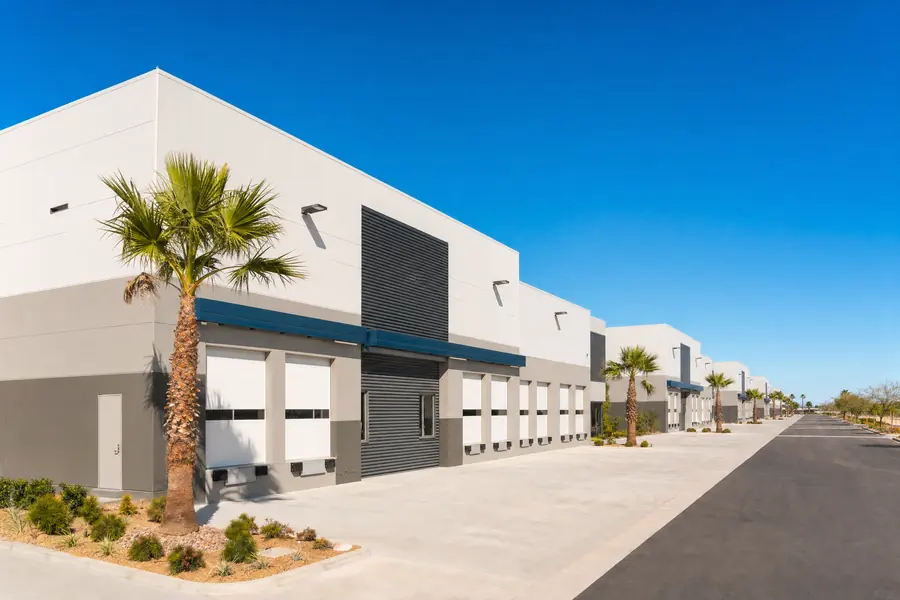
Flex space solves all four at once: a finished office front with an open bay behind it, usually with a roll-up door and better power than any office suite. The regional inventory for exactly that is substantial, and it is cheaper per foot than office almost everywhere.
Where the small-bay flex inventory actually is
These are industrial and light-manufacturing buildings under 2,500 square feet — the size band where a design firm would take a single unit with an office front:
| City | Industrial buildings under 2,500 SF | Total industrial | Median year built |
|---|---|---|---|
| Hialeah | 953 | 2,528 | 1981 |
| Doral | 566 | 1,914 | 1997 |
| Pompano Beach | 381 | 1,553 | 1983 |
| Medley | 359 | 1,005 | 1987 |
| Fort Lauderdale | 289 | 1,322 | 1974 |
| Opa-locka | 286 | 559 | 1980 |
| Hialeah Gardens | 247 | 362 | 2002 |
| Sweetwater | 239 | 480 | 2008 |
| West Palm Beach | 189 | 884 | 1978 |
| Sunrise | 184 | 384 | 1990 |
| Dania Beach | 176 | 401 | 2005 |
| Deerfield Beach | 173 | 607 | 1984 |
| Coral Springs | 110 | 245 | 2000 |
Two rows deserve attention. Hialeah Gardens has 247 of its 362 industrial buildings under 2,500 square feet at a median construction year of 2002, and Sweetwater has 239 of 480 at a median of 2008. Those are modern small-bay condominium units — good clear height, impact glazing, proper power, parking at modern ratios — and they are the single best-kept secret for a design firm that wants a clean office front with workable space behind it.
Coral Springs and Dania Beach are the same proposition in Broward, at median vintages of 2000 and 2005.
The honest downsides of flex
I am not going to sell you flex without the costs, because there are real ones.
Address and appearance. A business park is not an impressive place to receive a public-sector client or a developer, and for some firms that matters. The counter is that the office front of a good flex unit, properly built out, reads as a normal office once you are inside it — and most engineering and architecture clients visit a job site more often than they visit your office.
Zoning and permitted use. Industrial zoning does not automatically permit professional office use, and the proportion of a unit that may be office is sometimes capped by code. This is the item that most often stops a flex deal after the handshake, so confirm your use in writing with the municipality before you sign and make execution contingent on it. Do not infer permission from what the neighbours appear to be doing.
Build-out. The office front is finished to a lower standard than an office building, and the allowance on a small industrial unit is usually minimal or absent. Expect as-is plus a few weeks of free rent, which makes the condition of what you are shown most of what you are buying.
And the common areas are what they are. No lobby, no shared conference room, no cleaning service unless you arrange it.
The parking math that quietly decides this
If the flex route falls apart for one of my engineering clients, it is almost always parking, and it is almost always discovered too late. This is the constraint I check before I check the rate.
Industrial buildings are parked for industrial use. A warehouse with four employees and a forklift does not need many spaces, so the zoning code typically requires something in the neighborhood of one space per thousand square feet, and the developer built to the requirement because asphalt is expensive and dock apron is more valuable. Office buildings in the same municipalities are generally parked at three to five spaces per thousand.
Now put your firm in that building. A design office runs roughly one person per two hundred to three hundred square feet. Take 4,000 feet of flex and you are plausibly fifteen to twenty people, which needs fifteen to twenty spaces plus visitors. At one per thousand, the building owes your bay four. You can see the problem, and so can the city, which is the part people miss.
The city sees it at certificate-of-use or business-tax-receipt stage. Many tri-county municipalities will not issue a certificate of use for an office occupancy in an industrial building unless the parking supplied matches the office requirement for the square footage you are converting. So the deal does not fail at the lease, it fails after you have signed, spent money on plans, and told your staff where they are moving.
What I do about it, in order. First, I count the striped spaces that the bay actually controls, not the spaces on the site plan, because in multi-tenant industrial parks the neighbor's trucks live in them by custom. Second, I ask the landlord to allocate a specific number of spaces to the premises in the lease, by count and ideally by location, rather than accepting "non-exclusive parking in common areas." Third, before the lease is signed I have the zoning question answered in writing by the municipality for that address and that use, not by the listing broker's recollection. That last step takes a week and it has saved clients of mine from signing deals that could not legally open.
Where the parking genuinely will not work, there is sometimes a fix: a shared-parking agreement with an adjacent owner whose demand peaks at a different hour, or a lease structured so a portion of the square footage stays classified as storage or shop rather than office. Both are real solutions. Both need to be arranged before you sign, not after.
What the two options actually cost, side by side
Everything above is about whether flex suits how a design firm works. This is the part where the choice gets priced. These are county-recorded sales since 2021, office buildings in the 2,000 to 6,000 foot range against small industrial buildings in the same cities, so you are comparing the basis under each option rather than one broker's asking rate against another's.
| City | Office buildings 2,000–6,000 SF | Median year built | Office median $/SF | Small industrial median $/SF | Industrial sales |
|---|---|---|---|---|---|
| Miami | 418 | 1970 | $463 | $392 | 40 |
| Fort Lauderdale | 229 | 1965 | $421 | $287 | 44 |
| Coral Gables | 186 | 1981 | $606 | — | 0 |
| West Palm Beach | 124 | 1966 | $440 | $264 | 36 |
| Hollywood | 109 | 1968 | $329 | $306 | 21 |
| Hialeah | 64 | 1975 | $433 | $221 | 109 |
| Pompano Beach | 63 | 1967 | $267 | $224 | 51 |
| Oakland Park | 58 | 1970 | $260 | $241 | 30 |
The spread is the whole story, and it is nothing like uniform. In Hialeah small industrial carries about half the basis of office, $221 against $433, across 109 recorded sales. That is a deep sample and a real discount. In West Palm Beach and Fort Lauderdale the gap is also wide. In Hollywood, Pompano Beach and Oakland Park it nearly closes, and in Oakland Park office is within twenty dollars a foot of industrial.
What that means practically: the flex play pays for itself in some submarkets and is close to a wash in others. If you are looking in Pompano Beach or Oakland Park, where office basis is $267 and $260, there is not much savings left to justify giving up the parking ratio and the finished lobby. Go take the office space. If you are looking in Hialeah or Fort Lauderdale, the discount is big enough to be worth designing around.
Coral Gables is in the table precisely because it has nothing in the industrial column. There is effectively no small industrial stock inside the city, so the flex option does not exist there at any price. If your client base or your principals require a Gables address, you are leasing office at the highest basis in this table and the only question left is which building.
One caution on the right-hand columns. The industrial sale counts tell you how much to trust the number beside them. Hialeah at 109 sales is a solid distribution. Hollywood at 21 is thinner and I would treat $306 as indicative. Where the count is low, the median can swing on two unusual deals.
If you do want conventional office
Plenty of design firms do, particularly architecture practices whose clients visit and whose brand is partly spatial. If that is you, the requirements shift to the things that make an open studio work.
Look for larger floor plates and fewer existing partitions, because the expensive thing in converting an office suite to a studio is demolition. A shell or a previously open tenancy is cheaper to fit than a suite carved into eight private offices.
Check electrical capacity for plotters and for a studio full of large monitors, and check whether the panel supports the load without an upgrade. Ask about floor loading if you are storing drawings or samples at volume. And look hard at lighting — a design studio cares about daylight and colour rendering in a way an accounting practice does not, so the orientation of the glazing is a real criterion rather than a preference.
Acoustics matter in the opposite direction from a law firm. You want the open studio to work as a collaborative space while keeping client conference and principal conversations private, which means deck-to-deck partitions on the conference room and the principals’ offices and nothing much elsewhere.
Hosting a plan review, and the satellite office question
Two practical situations come up for design firms that the flex-versus-office framing does not quite cover.
The first is hosting. If you run plan reviews or coordination meetings with clients, contractors and consultants in your office, you need one room that seats eight to twelve around a surface with a wall to project or pin onto. That is a specific requirement and it is the main argument for conventional office over flex — though a well-built flex office front handles it perfectly well, and I have put that room in several of them.
The second is the satellite. Firms winning work in a county they are not based in often want a small presence near the project or near the permitting office, and the answer there is usually not a lease at all. A shared suite, an executive office or a desk arrangement for twelve to twenty-four months gives you the address and a place to meet without committing to five years in a market you may not stay in. The all-in rate per foot looks high and the total cost is low, which is the right way round for a temporary requirement.
What I would avoid is signing a conventional five-year lease on a satellite because a single contract justified it. Contracts end. Leases do not.
The term length problem, and project-based revenue
Design firm revenue is lumpy and project-driven in a way that makes a long fixed obligation uncomfortable. Three tools help, and all three are cheaper to obtain at signing than to buy later.
A contraction right — a one-time option at a defined point, usually end of year three, to hand back a defined block of space with notice. Landlords typically price it by asking you to repay the unamortised allowance and commission on the returned footage, which is a fair trade. Insist the returned block is identified on a plan attached to the lease; an undefined contraction right the landlord must approve is not a right.
An expansion option on identified adjacent space at a defined rate, which protects you from winning a large project and having nowhere to put the team.
And a sublease right with a reasonable consent standard, so if a project pipeline collapses you have somewhere to go other than to the landlord for mercy.
On personal guaranties, the usual advice applies: negotiate duration rather than existence, with a burn-off after twenty-four or thirty-six months of clean payment or a cap expressed in months of rent. How to negotiate a personal guaranty covers the detail.
How I would run this search
Price both. Get real quotes on two or three small-bay flex units and two or three conventional office suites in the same trade area, then put them on the same basis — base rent, operating expenses or association assessments, the cost of building out the office front, power upgrades, and what restoration will cost at the end. Industrial space is more often triple-net than small office space is, so the two quoted rates are not comparable until somebody does that work. How triple-net leases work in Florida covers the mechanics.
Then confirm zoning on anything you like, in writing, from the municipality. Most firms I run this exercise with end up in flex and save real money. They land there having seen the numbers rather than having assumed them.
Both sides are covered on the service pages: industrial tenant representation for flex and office tenant representation for conventional suites.
Frequently asked questions
Should an engineering firm lease office or flex space?
Flex usually wins on cost and function. A design firm needs plan storage, large-format output, a layout or pin-up surface and sometimes samples or equipment, and a flex unit with a finished office front handles all of it with better power and a roll-up door. Industrial space also trades below office per square foot in every county here. The trade-offs are address, a minimal build-out allowance, and confirming that the zoning permits professional office use.
Where is the newest small-bay flex space in South Florida?
Hialeah Gardens and Sweetwater in Miami-Dade, and Dania Beach and Coral Springs in Broward. Hialeah Gardens has 247 of its 362 industrial buildings under 2,500 square feet at a median construction year of 2002; Sweetwater has 239 of 480 at a median of 2008. Those are modern small-bay units with proper power, clear height and parking — the best fit for a firm wanting a clean office front with working space behind it.
Does industrial zoning allow office use?
Not automatically, and the proportion of a unit that may be office is sometimes capped by code. This is the item that most often kills a flex deal after the handshake. Confirm your specific use in writing with the municipality before signing and make lease execution contingent on that confirmation. Never infer permission from what the neighbouring tenants appear to be doing.
How do I handle lease length when revenue is project-based?
Negotiate flexibility rather than a shorter term. A contraction option at a defined point with the returned block identified on a plan, an expansion option on identified adjacent space at a defined rate, and a sublease right with a reasonable consent standard. All three are far cheaper to obtain at signing than to buy your way out of later, and landlords concede them more often than tenants expect.
Who pays the broker when a design firm leases space?
The landlord, out of the transaction, on both office and industrial deals in this market. There is no cost to you for having your own representation, and dealing directly with a listing agent saves you nothing because that agent is already being paid by the owner.
How much parking does an engineering office need?
Plan on one space per employee plus visitor capacity, which for a design firm works out to roughly one space per 200 to 300 square feet of occupied space. That is the number your staff needs. The number the building supplies may be very different: industrial buildings are commonly parked near one space per thousand square feet, office buildings at three to five. Before signing in a flex building, count the spaces the premises actually controls, get a specific allocation written into the lease, and confirm with the municipality that the parking supplied satisfies an office occupancy at that address.
Can an engineering firm get a certificate of use for office space in an industrial building?
Often yes, but it is a question for the municipality and the specific address, not a general rule. Many industrial zoning districts in the tri-county area permit office as an accessory or limited use, and some permit it outright. The common failure point is parking: the city may require the office portion to be parked at the office ratio, and an industrial site frequently cannot supply it. Get the answer in writing from the city for your address and your intended use before the lease is signed, because this is the kind of problem that surfaces after you have already spent money.
Is flex space actually cheaper than office space in South Florida?
It depends heavily on the submarket, and the gap is not uniform. Looking at recorded sales since 2021, small industrial in Hialeah carries roughly half the basis of office there, and Fort Lauderdale and West Palm Beach show wide spreads as well. In Pompano Beach, Oakland Park and Hollywood the two are close enough that the savings may not justify the trade-offs in parking, finishes and image. Coral Gables has effectively no small industrial stock, so the option does not exist there. Price the specific submarket rather than assuming flex is cheaper everywhere.