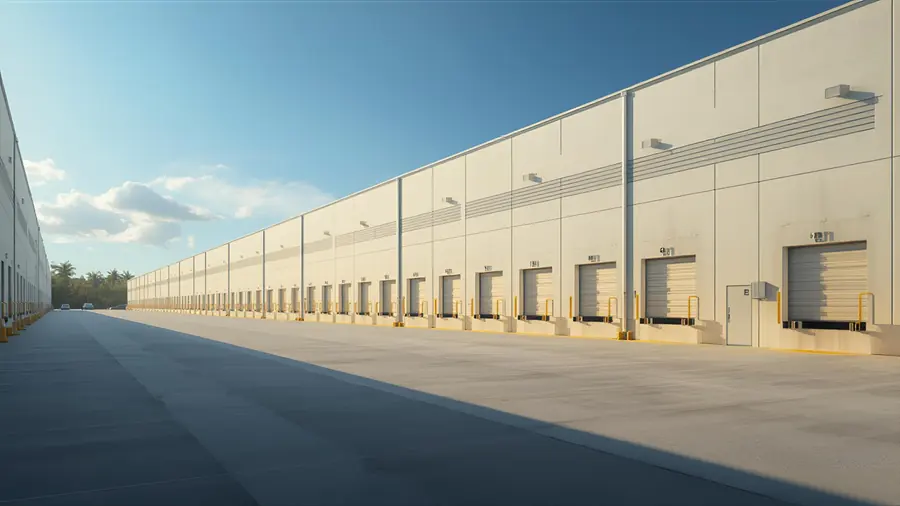
Part of commercial tenant representation in Florida — what the law presumes about your broker, and who pays the fee.
Industrial leases live or die on physical specs
Office tenants worry about rate. Retail tenants worry about traffic. Industrial tenants worry about whether the building can physically do the job. Clear height, dock door count and configuration, power capacity and service, column spacing, truck court depth, floor load capacity, and zoning — these are not negotiable line items in a lease. They're building constraints that either work or they don't.
Recent work: Crush Swimwear — a 2,200 SF flex requirement with a retail front and 22 ft clear behind it, placed in the Pompano Beach warehouse district in about 30 days with a fully renovated space on a short term.
Justin's industrial representation starts before rate is ever discussed. If the physical building can't run your operation at scale, the deal shouldn't proceed regardless of how good the rent looks.
What Justin evaluates on every industrial deal
Physical building specifications
- Clear height (critical for racking and vertical storage). 24' minimum for modern distribution. 32'+ for high-volume racking. 40' clear is becoming standard in new-construction logistics product.
- Dock doors — dock-high vs grade-level, count per square foot, positioning (cross-dock vs rear-load), dock levelers, seals.
- Truck court depth — 130' minimum for 53' trailer turning. 180'+ for maneuverability with drop trailers.
- Power capacity — amps, voltage, three-phase availability. Undersized power kills manufacturing and data-heavy operations. Power upgrades are expensive and slow to permit in South Florida.
- Column spacing and floor load — relevant for racking layout and heavy equipment.
- Zoning — M-1 vs M-2 vs IL. Your operation needs to match the underlying zoning exactly. Non-conforming uses trigger code enforcement.
- Parking ratios — particularly important for flex space with office component.
Lease-specific negotiation points
- Triple net (NNN) cost structure. Industrial is almost universally NNN. CAM caps, tax pass-through structure, insurance gross-ups all need to be controlled.
- Rent and rate structure. Industrial rates in South Florida have been pushed dramatically since 2020. Current Class A logistics product in Medley and Miami Lakes is $14–$18/SF NNN; older product in Pompano runs $10–$14/SF NNN.
- TI allowance. Warehouse TI is typically low ($3–$15/SF) because there's not much to build. Office TI within the warehouse (showrooms, executive offices) is negotiated separately.
- Operational rights. 24/7 operation rights, exterior storage rights, truck parking, loading procedures — all need to be explicitly granted.
- Environmental. Prior use disclosures, indemnification for pre-existing contamination, Phase I/II requirements. Critical for industrial users coming into older buildings.
- Expansion and contraction rights. ROFR on adjacent space. Right to terminate if business needs change.
- Personal guaranty structure. Same playbook as office — push to good guy guaranty, rolling burn-off, or capped dollar amount.
South Florida industrial submarkets
Medley & Miami Lakes
Class A Logistics · Port of Miami
Primary Class A logistics corridor. 32'–40' clear, modern dock configurations, close to airport and port. Heavy e-commerce and logistics. Rates $14–$18/SF NNN.
Doral & Airport West
Flex · Corporate HQ · Trade
Flex space, corporate regional headquarters, import/export operations. Mixed product age. Rates $12–$16/SF NNN for flex; $14–$18/SF NNN for modern warehouse.
Pompano Beach
Established · Mid-Box · Flex
Older Broward industrial core. Mid-box distribution, light manufacturing, service-based tenants. Rates $10–$14/SF NNN.
Davie & Sunrise
Small-Box · Local Distribution
Small to mid-box industrial, last-mile distribution, HVAC and construction support. Rates $11–$15/SF NNN.
Riviera Beach & West Palm
Palm Beach Industrial Core
Primary Palm Beach County industrial market. Marine and boating support, light manufacturing, local distribution. Rates $9–$13/SF NNN.
Miramar & Pembroke Pines
Modern Logistics · E-Commerce
Newer logistics product along I-75. Class A distribution, e-commerce fulfillment. Rates $13–$17/SF NNN.
Critical upfront diligence: Before signing an LOI on industrial space, get the electrical one-line diagram, sprinkler specifications (density and design), floor load rating, certificate of occupancy, and zoning verification. These take days to pull and can kill a deal before ink hits paper — much better to know early.
What industrial space actually sells for here
Industrial is the tightest-priced asset class in South Florida, which matters when you are negotiating. Recorded arms-length sales put the median at $264 per square foot in Miami-Dade, $226 in Palm Beach and $212 in Broward — and Broward industrial specifically ran a middle half of just $168 to $275 across 685 sales. Narrow bands mean the comps agree, which cuts both ways: you will not find a bargain nobody noticed, and a landlord cannot credibly claim their building is exceptional.
Size is the other lever. Across all three counties the median runs $410/SF under 2,500 SF against $209/SF above 25,000, because buyer depth collapses as buildings get bigger. Full detail on what is my commercial property worth and Broward commercial property values. For a flex requirement that has to receive customers as well as ship product, see the Crush Swimwear case study.
Common mistakes industrial tenants make
- Touring without a rep. Listing brokers show you what's on their list, not what fits your operation. A tenant rep runs the full market including off-market and sublet opportunities.
- Not verifying power capacity in writing. "There's 800 amps" from a listing broker means nothing. Get it in writing from the landlord, tied to the lease.
- Overlooking truck court and trailer parking. A building with five docks but no space to stage 53' trailers is operationally useless for distribution.
- Accepting undefined TI. "Landlord to deliver in broom-swept condition" is not a TI commitment. Delivery condition should specify dock levelers, HVAC (if applicable), paint, signage, lighting.
- Ignoring environmental history. Older industrial sites have environmental baggage. Phase I environmental reports and landlord indemnification are non-negotiable for any tenant with a risk profile.