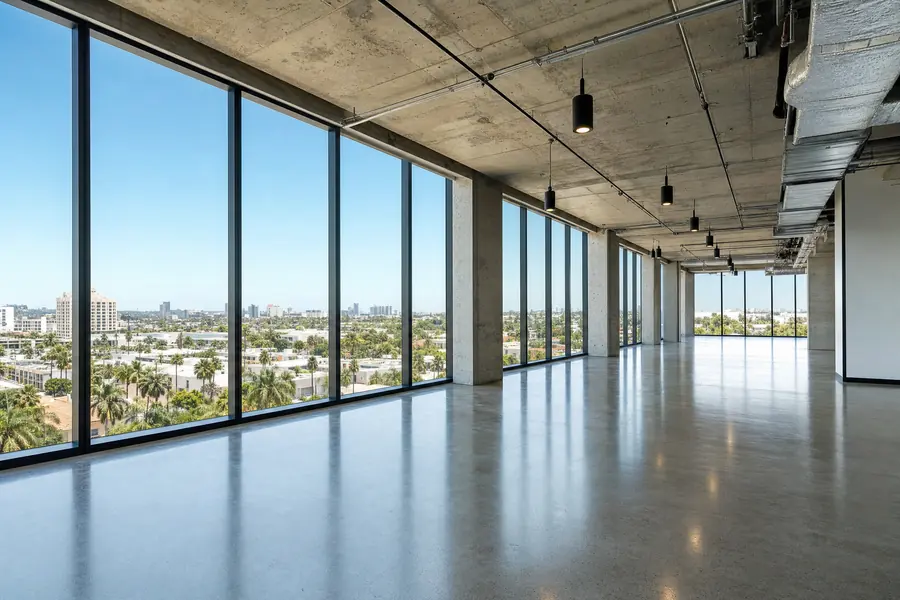
An accounting firm does not occupy its office the way the rent is calculated. For eight months of the year a twelve-person firm uses a twelve-person suite. From the second week of January through the middle of April it runs seasonal preparers, extended hours, Saturdays, and a reception area that actually has people sitting in it. Then it empties out again.
Landlords price square footage. They do not price that curve. I represent tenants and never landlords, so the job here is to get you a suite that survives busy season without paying rent on busy season for the other eight months.
Small suites carry a per-foot penalty, and the records show how big it is
Most CPA firms I work with land somewhere between 1,200 and 3,000 square feet. That puts them in the most expensive part of the office market on a per-foot basis, and the county records are blunt about it. These are recorded sale prices per square foot for office and professional-services buildings across the tri-county area, sorted by building size:
| Building size | Broward | Miami-Dade | Palm Beach |
|---|---|---|---|
| Under 1,500 SF | $294 | $395 | $333 |
| 1,500–2,499 SF | $258 | $317 | $191 |
| 2,500–4,999 SF | $221 | $230 | $231 |
| 5,000–9,999 SF | $173 | $176 | $207 |
| 10,000 SF and up | $143 | $154 | $189 |
Broward and Miami-Dade run clean and monotonic. The smallest buildings trade at roughly double the per-foot price of the largest ones, off 3,490 recorded sales in the under-1,500 Miami-Dade tier alone. Palm Beach does not follow the same line, and I would not read much into its under-1,500 figure: that tier has only 168 buildings and 108 recorded sales behind it, which is a small enough sample that one unusual year can move the median.
Sale prices are not rents. But they track the same underlying thing, which is that small space costs more per foot to own, to insure, to manage and to lease. When a landlord quotes you $34 a foot on a 1,400-foot suite in a building where the 8,000-foot tenant is paying $26, that is not a landlord taking advantage of you. That is the market this firm size sits in. What is negotiable is everything bolted onto that number.
Three ways to size a firm with a seasonal headcount
This is the decision that drives everything else, and I see it handled badly more often than any other item on the list.
Lease for peak
The straightforward approach: take the square footage your January-through-April staffing needs and pay for it all year. It is simple, it is the most expensive, and it is occasionally correct — specifically when your seasonal people need real workstations with dual monitors and a locked drawer, when your firm is growing fast enough that this year's peak is next year's baseline, or when you are in a submarket with almost nothing available and the risk of being caught short is worse than the carry.
Lease for baseline and solve the peak differently
Take a suite sized for your permanent staff and absorb busy season with hoteling desks, a converted conference room, staggered shifts, and remote preparers. Most firms under about fifteen people can do this if they decide to early enough to design the space around it. The savings are real: at the Miami-Dade medians above, cutting 600 square feet off a 2,400-foot requirement is not a rounding error over a five-year term.
The lease side of this is a conference room you can actually convert. That means power and data in the floor or the walls rather than a single outlet by the door, lighting on its own switch, and a door that closes against the rest of the suite. Ask for those during build-out, when they cost the landlord a few hundred dollars, not after you have signed.
Take slightly more space with a right to give some back
The middle path, and my usual recommendation for a firm that is genuinely unsure. Take the larger suite and negotiate a contraction right — a one-time option at a defined point in the term, usually the end of year three, to hand back a defined block of space with notice. Landlords resist this and sometimes price it, typically by asking you to repay the unamortized portion of the allowance and commission on the returned square footage. That is a fair trade and usually a cheap one against the alternative of carrying the space blind for five years.
What I will not let a client sign is the version where the contraction right exists but the returned space is undefined, or where the landlord gets to approve the reconfiguration. A right the other side can veto is not a right.
The lease terms that busy season actually touches
Four items on a standard office lease behave differently for an accounting firm than they do for the insurance brokerage down the hall. These are the ones I push on.
After-hours HVAC, priced against your actual calendar
Nearly every multi-tenant office lease in South Florida defines building hours and charges for conditioning outside them. The published rate is usually somewhere between $45 and $85 an hour per zone, and it is almost never the real negotiation. The real negotiation is what counts as an hour, whether Saturday morning is included in base hours, and whether there is a minimum charge per activation.
Run the arithmetic on your own March. A firm working four weeknights a week and Saturdays for ten weeks is looking at a line item that can run into five figures over a season. I would rather negotiate a block of included after-hours hours into the lease, or extended base hours during a defined seasonal window, than argue about the hourly rate. Landlords give the hours more readily than they give the rate, because the hours do not reset their published number for the next tenant.
Parking, counted for the week you actually need it
Parking in a suburban office park is typically expressed as a ratio, something like four spaces per thousand square feet, and in a 2,000-foot suite that is eight cars. In February you may have fourteen people in the building and clients dropping off documents. Find out before you sign whether the ratio is a hard allocation or a general right to use the lot, where the overflow goes, and whether the building has any history of towing. On a street-level or downtown location, ask who validates and what it costs.
Records storage is square footage you are paying full rate for
Firms carry paper, and a retention policy means carrying it for years. A room full of file cabinets at $30 a foot is an expensive filing system. Two things to look for: whether the building has basement, mezzanine or storage space available at a discounted rate, which many older buildings do and rarely advertise, and whether your floor loading and sprinkler coverage actually support dense file storage, which is a code question your landlord's architect should answer in writing rather than a question you discover during an inspection.
Server room power, cooling and the thing nobody checks
If you still run on-premise, your server closet needs dedicated circuits and supplemental cooling that does not shut off when the building HVAC does at 7 p.m. Supplemental cooling is a build-out item, it is not cheap, and it is the single most common thing I see left off a work letter. Get it in writing as landlord's work, or get it priced into the allowance, before the lease is signed.
Time the negotiation around your own year
Here is the practical point that costs firms the most money and has nothing to do with the building. A lease negotiation takes real attention from the person who runs the firm, usually across six to ten weeks. If your lease expires on May 31, the negotiation lands squarely in February and March, and it will get the leftovers of your attention. Landlords know how the calendar works.
So start early. For a firm of this size I want to be in the market nine to twelve months before expiration, which means the term sheet work happens in the autumn and the lease document gets reviewed before January. If your current lease expires in the spring, that is also an argument for negotiating a short extension at renewal so the next expiration lands in the summer instead. Moving your own deadline out of busy season is worth more than a dollar a foot.
The same logic applies to the build-out. Construction in a multi-tenant building takes longer than anyone's schedule says, and a delay that pushes your move into February is not an inconvenience for an accounting firm, it is a lost season. I write outside-date provisions with teeth into these leases for exactly that reason: a landlord-caused delivery delay past a stated date should produce free rent, and past a further date should let you walk.
Where the inventory is
If you want the small-suite counts city by city, the Fort Lauderdale office market page has the recorded data for that submarket and the other city pages cover the rest of the tri-county area. Miami, Coral Gables, Doral and Miami Lakes carry the deepest concentration of sub-2,500-foot professional office product; Coral Gables is also consistently the most expensive of them on a recorded basis, which is worth knowing before you fall in love with an address on Ponce.
How the representation itself works, and why it does not cost you anything, is covered on the office tenant representation page. If your firm is a law practice rather than an accounting one, the pressure points are different enough that I wrote them up separately: law firm office space in South Florida. And if you are not yet sure how much space you need at all, start with how much commercial space do I need.
Frequently asked questions
How much office space does a CPA firm need per person?
Planning at 150 to 200 square feet per permanent staff member covers private offices for partners, open workstations for staff, a conference room and a reception area in most firms this size. The number that matters more is how you handle seasonal headcount, because sizing for peak and sizing for baseline can differ by 25% or more in total square footage on the same firm.
Why is small office space more expensive per square foot?
Fixed costs do not scale down. A 1,400-foot suite needs the same restrooms, entry, HVAC equipment and management attention per tenant as a larger one, spread over fewer feet. The county records show it plainly on the sale side: across Broward and Miami-Dade, office buildings under 1,500 square feet have traded at roughly double the per-foot price of buildings over 10,000 square feet.
Can I get out of office space if my firm shrinks?
Not unilaterally, unless you negotiated for it. The tools are a contraction option at a defined point in the term, a sublease right with reasonable landlord consent standards, or an assignment right. All three are far cheaper to obtain at lease signing than to buy your way out of later. If flexibility matters, say so during the term sheet rather than during the lease review.
Should an accounting firm lease or buy its office?
Small-suite ownership is a more realistic option in South Florida than in many markets, because so much of the regional office stock is small. The trade is capital and flexibility against a fixed occupancy cost and an asset on the balance sheet. I am a broker and not a financial adviser, so run the capital side with your own numbers; what I can tell you is what comparable space has actually sold and leased for.
Who pays for a tenant representative on an office lease?
The landlord does, out of the transaction, at no cost to you. That is standard on essentially every office lease in this market. It also means going direct to the listing agent saves you nothing — that agent is already being paid, and they represent the building.