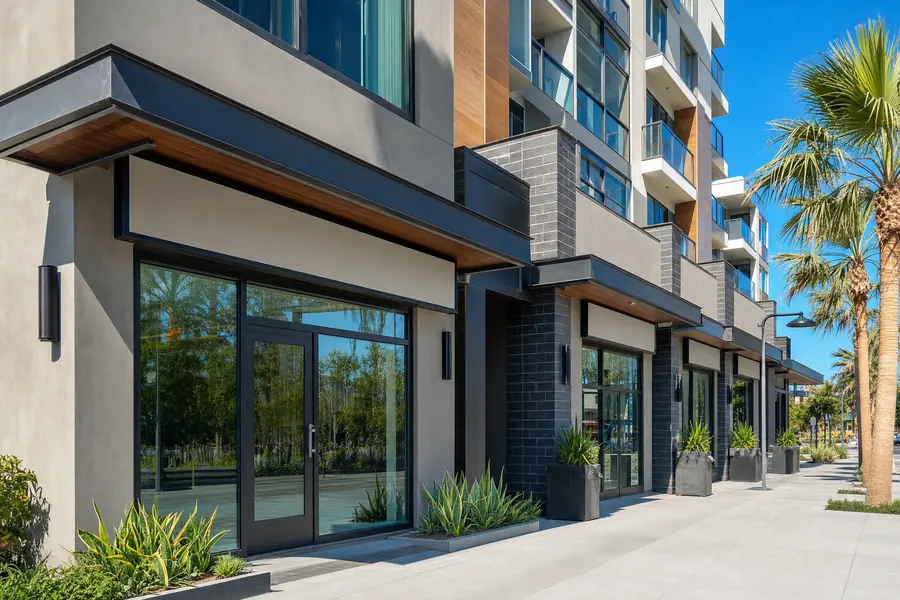
Every insurance agency I have toured space with starts in roughly the same place: do we need to be on the street, or will an office suite do? It sounds like a branding question. It is mostly an economics question, and the answer in South Florida is not the one most agency owners expect.
I represent tenants, so I have no reason to talk you into the more expensive option. Here is what the market actually looks like.
Street-level space trades below office space here, not above it
Take the size band an agency actually occupies — roughly 800 to 4,000 square feet — and compare what has recorded in the county books for small office buildings against single-story stores and small mixed retail in the same band:
| County | Office suite | Street-level store | Gap |
|---|---|---|---|
| Miami-Dade | $332/SF | $255/SF | 23% lower |
| Broward | $260/SF | $208/SF | 20% lower |
| Palm Beach | $233/SF | $208/SF | 11% lower |
Those are median recorded sale prices per square foot, drawn from 4,556 office sales and 2,351 street-retail sales in Miami-Dade, 1,253 and 866 in Broward, and 505 and 593 in Palm Beach. The pattern holds in all three counties and it is not subtle in two of them.
That runs against the instinct. Retail frontage feels like a premium product, and in a grocery-anchored center or on Lincoln Road it absolutely is. But the bulk of the small street-level inventory in this region is not that. It is older strip space on secondary corridors, bays in neighborhood centers, and ground-floor units in mixed buildings, and a lot of it competes for tenants with nail salons and takeout rather than with Class A office. An insurance agency walking into that market is a strong credit tenant with quiet hours and no grease trap, which is a position worth something.
So if visibility helps your agency, you are usually not paying a premium to get it. That changes the calculation.
When frontage earns its keep, and when it is decoration
Visibility is worth paying for when walk-in traffic converts. In practice that means a few specific situations.
A captive or franchise agency with a recognized carrier brand gets real value from a storefront, because the sign does marketing work every day whether anyone walks in or not. Personal lines agencies serving a dense residential neighborhood get value from it, because people genuinely do stop in to add a vehicle or ask about a renewal, and because the cash-and-document end of that business still happens in person in much of this market. An agency serving a Spanish-speaking or Creole-speaking clientele in a specific neighborhood often gets substantial value from being physically present in that neighborhood rather than in an office park eight minutes away.
Frontage is decoration when you write commercial lines, when your business arrives by referral and phone, or when your clients are other businesses who will never visit you. I have seen commercial-lines agencies pay for ground-floor retail for three years and count fewer than a dozen genuine walk-ins. In that case a suite on the second floor of the same building, or in a professional building nearby, does the same job for less money, with better parking and no plate glass to insure.
The honest test: if you cannot describe the customer who walks in, you do not need the window.
Signage is the term that decides whether the frontage was worth it
This is where I spend the most time on an agency deal, because three separate sets of rules have to line up and almost nobody checks all three before signing.
The first is the municipal sign code. Every city in the tri-county area regulates sign area, height, illumination and sometimes color, and the rules vary enough between neighboring cities that identical spaces a mile apart can allow very different signs. Some corridors are under overlay districts with stricter standards again.
The second is the landlord's sign criteria, which is usually an exhibit to the lease and is frequently stricter than the code. Channel letters only, no cabinet signs, a specified font, a specified maximum height, landlord approval of the drawing. Read that exhibit. It is the document that determines what your sign looks like.
The third is your carrier's brand standard, if you are captive or franchised. Carriers specify logo proportions, colors and sometimes exact sign products, and they do not care what the landlord's criteria says.
I have watched an agency sign a lease on a corner unit for the visibility and then discover the combination of city code and landlord criteria permitted a sign about a third of the size they had budgeted for. Get the sign drawing approved, in writing, by both the landlord and the city, before the lease is executed if you can, and at minimum make lease execution contingent on sign approval. A storefront you cannot put your name on is an expensive suite.
Three more items specific to agencies
The use clause, and somebody else's exclusive
Multi-tenant retail leases carry exclusive-use provisions. If a center already has an insurance agency with an exclusive, you may not be permitted in at all, or you may be permitted in with your permitted use written so narrowly that adding a line of business later breaches the lease. Ask for the center's existing exclusives in writing during the term sheet, and write your own permitted use broadly enough to cover insurance brokerage, financial services and general office use. An exclusive of your own is worth asking for in a smaller center; you will not always get it, but the ask is free.
Parking for the fifteen-minute customer
A walk-in agency needs spaces near the door, not spaces in the lot. In a shared center, the practical question is what is happening in the units around you at your busy hours. A unit two doors from a popular lunch spot has no parking from eleven to two, which is exactly when people run errands on a break. Visit at noon on a weekday before you sign anything. The lease will tell you the ratio; it will not tell you that.
What the build-out costs you on the way out
Carrier-branded interiors get specified down to the counter. Fine. The lease provision to watch is restoration: whether you are required at the end of the term to return the space to its original condition, remove your signage and patch the facade, and remove the counter and millwork you installed. Unqualified restoration language can turn into a five-figure bill in month sixty, and landlords will frequently agree to limit it to signage removal and facade repair if you raise it during negotiation. Raise it during negotiation.
Assignment, because agencies get sold
A book of business is an asset, and agency owners sell or merge more often than most small-business tenants do. If your lease prohibits assignment without landlord consent and says nothing about the standard for that consent, you have handed a third party a veto over your exit. The fix is small: consent not to be unreasonably withheld, with a stated response window, plus a carve-out permitting assignment to an affiliate or to a buyer of substantially all of your assets without consent. Ask for it at the term sheet and it is usually conceded. Ask for it when you have a buyer at the table and it becomes a negotiation you are losing.
Where the storefront inventory actually is
Agency owners tend to search by neighborhood and then discover there are four units in it. It helps to know where the depth is. Counting single-story stores and small mixed-retail buildings between 800 and 4,000 square feet in the county records, with the median recorded price per square foot alongside:
| City | Units in band | Median recorded |
|---|---|---|
| Miami | 1,345 | $257/SF |
| Fort Lauderdale | 420 | $215/SF |
| Miami Beach | 286 | $425/SF |
| West Palm Beach | 280 | $251/SF |
| Hollywood | 224 | $186/SF |
| Coral Gables | 216 | $485/SF |
| Hialeah | 198 | $119/SF |
| Lake Worth | 173 | $185/SF |
| Pompano Beach | 129 | $219/SF |
Two things jump out of that list. The first is the spread: Coral Gables and Miami Beach carry recorded prices roughly four times Hialeah's, inside the same county, for space in the same size band. Frontage is not one market here. It is a dozen markets with very different prices, and the right question is never “how much is a storefront” but “how much is a storefront on this corridor.”
The second is that Hialeah's $119 is not a typo and not a bad neighborhood signal. It is a deep, older, heavily owner-occupied small-commercial stock serving a dense residential population, which is close to the ideal profile for a personal-lines agency and is priced accordingly. I have placed agencies in that kind of corridor who out-produce agencies in buildings that cost three times as much per foot, because the clients live within a mile.
Hollywood and Lake Worth sit in a similar bracket with similar logic. If your book is personal lines and neighborhood-driven, the cheap corridors are not a compromise. They are the strategy.
How I would run this decision
Price both. Not conceptually — actually. Get real quotes on two or three street-level units and two or three office suites in the same trade area, then put all of them on the same basis: base rent, operating expenses, insurance, the real cost of signage, the restoration exposure at the end, and any parking charge. Retail space in this market is more often on a triple-net basis than small office space is, which means a quoted retail rate and a quoted office rate are not comparable until somebody does that work. How triple-net leases actually work in Florida covers the mechanics.
Then weigh the difference against the walk-in business you can honestly forecast. Most agencies I have done this exercise with land on street-level space, because the gap in the table above means frontage is cheap here. But they land there having seen the number rather than having assumed it.
Both sides of the market are covered on the service pages: retail tenant representation for storefront space and office tenant representation for suites. Miami, Fort Lauderdale, Miami Beach, West Palm Beach, Hollywood and Lake Worth hold the deepest small storefront inventory in the records; West Palm Beach office space is a good example of how the two options sit side by side in the same city.
Frequently asked questions
How much space does an insurance agency need?
Most independent agencies I work with land between 800 and 2,500 square feet. That covers a reception or counter area, two to six producer offices or workstations, a small conference space and file storage. Agencies with heavy walk-in personal lines business weight more of that toward the front of the space; commercial-lines agencies weight it toward private offices.
Is retail space more expensive than office space in South Florida?
In the small size band an agency occupies, the county records say the opposite. Median recorded sale prices for single-story stores and small mixed retail between 800 and 4,000 square feet run 11% to 23% below comparable small office buildings, depending on the county. Prime anchored and high-street retail is a different market and does carry a premium.
Can I put my carrier's sign on a leased storefront?
Only if the city sign code, the landlord's sign criteria and your carrier's brand standard all permit the same sign. Those three sets of rules often conflict. Get the sign drawing approved by the landlord and the municipality before you execute the lease, or make execution contingent on that approval.
What is an exclusive-use clause and does it affect an insurance agency?
It is a provision barring the landlord from leasing to a competing use within the center. If an existing tenant holds an exclusive covering insurance, it can keep you out or limit how your permitted use is written. Ask for the center's existing exclusives in writing before you sign, and negotiate your own permitted use broadly.
Who pays the broker when an agency leases space?
The landlord, out of the transaction. There is no cost to you for having your own representation on either a retail or an office lease in this market, and the listing agent you would otherwise deal with directly is already being paid by the building owner.