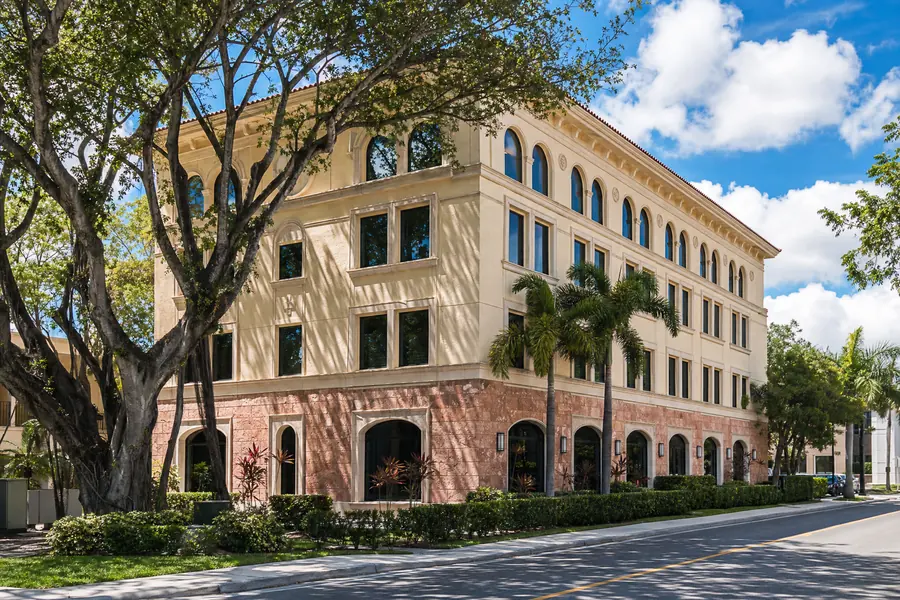
Advisors and RIA principals describe their space requirement to me in almost identical language. Quiet, private, a conference room a client would be comfortable sitting in, and a building that does not undercut the conversation they are about to have about someone's retirement. That is a reasonable brief. It is also a brief pointed at a slice of the South Florida office market that is far thinner than most people assume.
I represent tenants and not landlords, and the useful thing I can tell you up front is how thin.
Post-2000 office product is a minority of the market, and a small one
Here is every office and professional-services building in the tri-county records between 1,500 and 15,000 square feet, sorted by when it was built, with the median recorded sale price per square foot alongside:
| Built | Broward | Miami-Dade | Palm Beach | |||
|---|---|---|---|---|---|---|
| Bldgs | $/SF | Bldgs | $/SF | Bldgs | $/SF | |
| Before 1980 | 1,154 | $194 | 2,012 | $212 | 661 | $189 |
| 1980s | 354 | $188 | 766 | $258 | 245 | $191 |
| 1990s | 164 | $248 | 198 | $219 | 132 | $223 |
| 2000s | 346 | $228 | 724 | $364 | 195 | $247 |
| 2010 or later | 52 | — | 245 | $448 | 74 | $170 |
Read the counts, not just the prices. In Broward, 398 of 2,070 buildings in that size range were built in 2000 or later. That is 19%. Buildings from 2010 onward number 52 in the entire county — I have left the price off that row because 36 recorded sales is too thin a base to publish a median from with a straight face. Miami-Dade is better at about 25% post-2000 and Palm Beach sits near 21%, but nowhere in this region is modern small-floorplate office space abundant.
Which means four out of five buildings you will be shown were built before the millennium, most of them well before. For an advisory practice that is not automatically disqualifying, and I will come back to what to look for in an older building. But it does explain the price column: in Miami-Dade, 2000s product has recorded at $364 a foot against $212 for pre-1980, and 2010-and-later product at $448. You are bidding into scarcity.
The cities that actually have modern inventory
Since the post-2000 stock is the scarce part, it is worth knowing where it sits. Office and professional-services buildings between 1,500 and 15,000 square feet, built in 2000 or later, by city:
| City | Post-2000 buildings | Median recorded |
|---|---|---|
| Coral Gables | 171 | $497/SF |
| Miami | 159 | $526/SF |
| Coral Springs | 87 | $233/SF |
| Miami Lakes | 64 | $222/SF |
| Aventura | 61 | $632/SF |
| Fort Lauderdale | 49 | $246/SF |
| South Miami | 45 | $463/SF |
| Weston | 43 | $169/SF |
| West Palm Beach | 37 | $279/SF |
| Davie | 35 | $223/SF |
Fort Lauderdale having 49 post-2000 buildings in this size band surprises people, including people who work there. The downtown office growth of the last two decades went into large-floorplate towers, which are a different product and a different conversation; the small professional building did not get rebuilt at anything like the same rate.
The price spread is the actionable part. Aventura at $632 and Coral Gables at $497 are address markets, and clients do read an address. Coral Springs at $233, Miami Lakes at $222, Davie at $223 and Weston at $169 are the same vintage of building at roughly half to a third of the recorded price. If your book is local to western Broward, paying Gables rates for a Gables address is buying a signal your clients were not asking for.
What scarcity does to your negotiating position
Standard advice says a tenant with options has leverage. The corollary is the part advisors need to hear: if your requirement is a 2,500-foot suite in a post-2000 building in a specific submarket, you may genuinely have two options, and the landlord will know that before you walk in.
Three practical responses. The first is to widen the geography before you widen the compromise. Coral Gables holds 171 post-2000 buildings in this size range and Miami 159, but Coral Springs has 87, Miami Lakes 64 and Weston 43, at recorded medians of $233, $222 and $169 against Coral Gables' $497. If your clients come to you rather than the other way round, a fifteen-minute shift west can double your option set and halve your rate.
The second is to separate the things you actually need from the things you are using as proxies for them. You do not need a 2015 building. You need a clean entry sequence, a conference room with real acoustic privacy, a working elevator, restrooms a client will not comment on, and HVAC that holds temperature during a two-hour meeting. A well-managed 1987 building with a renovated lobby delivers every one of those. A 2006 building with deferred maintenance and a tired common area delivers none of them.
The third is to put the building's condition in the lease rather than trusting the tour. Ask when the roof, chillers and elevators were last replaced. Ask for the last two years of operating expense reconciliations, which tell you more about how a building is run than any tour will. In an older building, ask for a cap on controllable operating expense increases; the whole risk of an aging building is that its repair bill becomes your line item.
The build items that matter for client-facing advisory space
Acoustic privacy, and the specific failure mode
The reason this matters for an advisory practice is not confidentiality theater. It is that your client will not say the real thing if they can hear the conversation in the next room, because they will correctly assume the reverse is also true. A standard office demising partition runs to the underside of the ceiling grid, which means sound travels over the top through the ceiling plenum and the shared return air path.
The fix is a deck-to-deck partition with insulation and sealed penetrations around the conference room and the principal's office, plus ducted rather than plenum return on those rooms. Specify it in the work letter. It is modestly more expensive than a standard partition and it is far more expensive to retrofit after you have moved in, because the ceiling has to come down.
The entry sequence
Put the conference room where a client reaches it without walking past your staff's screens. That sounds like interior design and it is partly a compliance habit: client documents, other clients' names and open positions should not be visible on the route from the front door to the chair. It also happens to be the thing that makes a modest suite feel considered. In a small floorplate this is a space-planning decision made once, at test-fit stage, and it costs nothing to get right then.
Technology, communications and continuity
Find out which carriers actually serve the building before you sign, not which ones say they serve the area. In older buildings in this market the answer is sometimes one provider, and a single-carrier building is a business continuity problem for a practice that trades. Ask about riser access and whether the landlord permits a second carrier to be brought in at your cost. Ask where the demarcation point is. If you need a server or network closet with supplemental cooling, that is a work letter item and it is the one most often omitted.
Continuity generally deserves a question of its own in this region. What happens to building access and power after a storm, is there generator capacity, and does it cover anything beyond life safety. Most small buildings here will tell you honestly that it does not.
Signage and identity for a practice, not a brand
An independent RIA usually wants building directory and suite signage rather than exterior identity, which is straightforward and cheap. If you want anything on the exterior or the monument, ask early: in multi-tenant buildings those positions are frequently already allocated to larger tenants in perpetuity, and a landlord cannot give you what they have already given away.
Term length against a practice you may sell
Advisory practices get sold, merged and rolled up, and a lease is one of the few parts of a small practice that can complicate a transaction. Two provisions carry nearly all of that risk.
Assignment is the first. If consent is required and no standard is attached to it, a landlord can slow or complicate a sale of your book. The language to push for is consent not to be unreasonably withheld with a defined response period, plus an express carve-out allowing assignment to an affiliate or to a buyer of substantially all of the practice's assets without consent. Conceded routinely at term sheet stage; much harder once you have a buyer.
The personal guaranty is the second. A small advisory entity with limited hard assets will usually be asked for one. The realistic negotiation is duration rather than existence: a burn-off after twenty-four or thirty-six months of clean payment history, or a cap expressed as a fixed number of months of rent rather than the full remaining term. How to negotiate a personal guaranty covers the mechanics in detail. Unlimited guaranties on long terms are the single most common thing I ask clients to go back on.
On term length itself, the trade is simple. Longer terms buy you a bigger allowance and a lower rate; shorter terms buy you optionality. For a practice that might transact within five years, I would rather take a five-year term with a renewal option at a defined rate than a ten-year term at a slightly better number.
One timing note that follows directly from the counts above. When the qualifying inventory in your submarket is two or three buildings, you cannot run a ninety-day search. Start twelve months before expiration. That is long enough to watch a second space come available, to put a renewal proposal from your current landlord next to a relocation proposal, and to let the landlord know you are not cornered. In a thin market, time is most of the leverage you are going to get.
Where to look
Coral Gables office space is the deepest market in the region for exactly this requirement and priced like it. The office tenant representation page covers how the engagement works and why it costs you nothing. If your practice is medical rather than financial, the constraints are different again: medical office space in South Florida. And when you have two proposals in hand, what to ask for in a tenant improvement allowance is where most of the recoverable money sits.
Frequently asked questions
How much office space does a financial advisor need?
A solo advisor with one assistant works comfortably in 800 to 1,200 square feet if the conference room is sized properly. A four-to-six person practice generally wants 1,800 to 3,000. The conference room is the room that drives the plan, because it has to seat a couple plus you with real acoustic separation, and squeezing it is the compromise clients notice.
Is newer office space worth the premium in South Florida?
Sometimes, and the premium is steep. In Miami-Dade, office buildings of this size built in the 2000s have recorded at a median of $364 per square foot against $212 for pre-1980 product. What you are often buying is scarcity rather than performance: a well-maintained 1980s building with a renovated lobby, replaced chillers and capped operating expenses can serve a client-facing practice just as well.
How do I keep client conversations private in a small office suite?
Specify deck-to-deck demising partitions with insulation and sealed penetrations around the conference room and principal's office, and ducted rather than plenum return air on those rooms. Standard partitions stop at the ceiling grid and sound carries over the top. It is a work letter item, and retrofitting it later means taking the ceiling down.
Will my lease complicate selling my advisory practice?
It can. An assignment clause requiring landlord consent with no stated standard gives a third party influence over your timing, and a full-term personal guaranty follows you. Negotiate consent that cannot be unreasonably withheld, a carve-out for a sale of substantially all assets, and a guaranty that burns off or is capped in months of rent.
Who pays the tenant representative on an office lease?
The landlord, out of the transaction, at no cost to you. That is standard across this market. It also means dealing directly with the listing agent saves you nothing, because that agent is already compensated and represents the owner.